
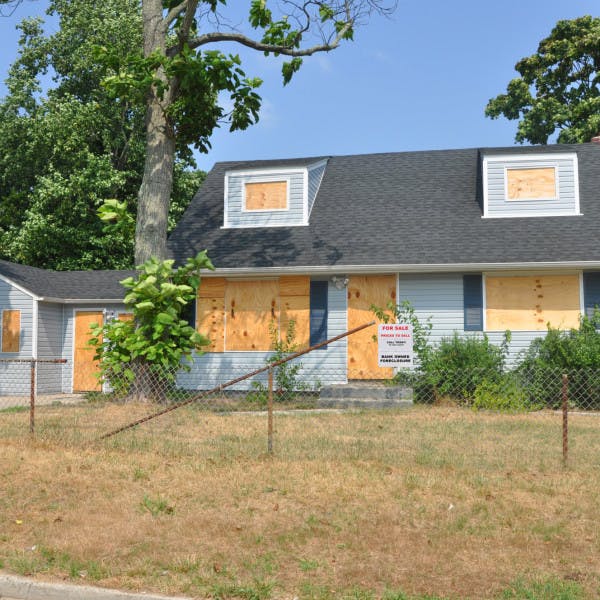
Foreclosures, short sales rise as homeowners weigh their options
Foreclosures jumped over 20% in the first half of 2026 while short-sale transactions increased 16% in Q1, according to new data from ATTOM and Realtor.com.


A total of 227,548 U.S. properties had foreclosure filings during the first six months of 2026, an increase of 21% year-over-year and up 28% from the first half of 2024, according to ATTOM's Mid-Year 2026 U.S. Foreclosure Market Report.
The uptick more likely signals market normalization than a housing market calamity, according to ATTOM CEO Rob Barber. "The combination of rising foreclosure starts, increased foreclosure completions, and shorter timelines points to a continued normalization of the foreclosure process, although the increases also suggest that some homeowners may be facing greater financial strain than they were a year ago," Barber said.
Where foreclosure rates were highest: In the first half of 2026, the five states with the highest foreclosure rates were Florida (where 0.27% of units had a foreclosure filing), South Carolina (0.26%), Indiana (0.25%), Delaware (0.25%) and Illinois (0.23%).
Annual increases in foreclosure activity jumped most in Idaho (up 59%), Colorado (up 57%) and Georgia (up 52%).
Foreclosure starts, repossessions up overall: Foreclosure starts were up 18% in the first six months of 2026 compared to the same period a year earlier, totaling 164,566 U.S. properties. Starts were also up 66% compared to the first half of 2020.
The number of bank repossessions (REOs) also grew on an annual basis, up 33% compared to the first half of 2025 for a total of 27,983 properties. The state with the most REOs in the first half of 2026 was Texas with 3,322, followed by California (2,644) and Florida (2,070).
The time to foreclosure has also been shrinking, ATTOM found, with properties foreclosed in the second quarter of 2026 spending an average of 563 days in the process — down 2% from Q1 and down 13% year-over-year.
Short sales gain traction: Short sales allow a homeowner who owes more on their mortgage than their home is worth to sell the home for less than their remaining mortgage balance — if the lender approves. Though these transactions are a relatively small portion of the housing market, they are growing in number as some homeowners look for an alternative to foreclosure, according to a recent Realtor.com study.
There were just over 28,000 short sales in 2025, accounting for about 0.6% of all home sales and 28% of distressed sales. Short-sale transactions increased 4% from 2023 and 2024, grew 10% from 2024 to 2025 and jumped 16% year-over-year in Q1 of 2026, Realtor.com reported.
"A short sale can be complicated and requires borrowers to act before the bank forces their hand; however, it benefits them by shortening the waiting period before they can qualify for a future mortgage," Realtor.com Chief Economist Danielle Hale said in a statement.
"Foreclosures are the more common outcome," Hale added, "but borrowers facing difficulty should consider all of their options."
Short sale, foreclosure discount swings now in line: Over the past 10 years, short sales typically sold for a bigger discount than foreclosures, Realtor.com noted, with discounts jumping from about 30% of a home's estimated value in 2018 to 50% in 2022. Meanwhile, foreclosed homes typically sold at a 25-30% discount during the same period. Today, however, short sale discounts have slimmed down to about 20% as the market has cooled off.
The market's changing pace has largely dictated short-sale discounts, Realtor.com noted. While foreclosed homes are priced by the lender at the exact time of the sale, short sales are priced while the seller still owns the home. Those short sales can be pending for months, with the home's value still capable of fluctuating as the lender decides whether to accept the discounted price.
Some pros, cons still make short sales rare: Short sales end earlier and allow a homeowner to qualify for a new mortgage in four years compared with seven years after a foreclosure. This is one reason short sales can seem more attractive to struggling homeowners.
While short sales are believed to be easier on a seller's credit than a foreclosure, many credit bureaus score them similarly. With foreclosures, homeowners are often permitted to remain in their home without paying for a much longer period — an average of 592 days, according to ATTOM data cited in Realtor.com's report.
"That free housing is worth more than any credit or timeline advantage a short sale offers, and the new pricing math doesn't touch that calculation," Glen Morgenstern, an economist intern with Realtor.com, said in a news release. "A short sale recovers more value for the lender and does less damage to the surrounding neighborhood, but the decision isn't the lender's to make."